

Board Performance · 2025
In this section15 topics
- Compliance Monitoring — Overview1 item
- Prevention of Conflicts of Interest3 items
- Prevention of the Use of Inside Information3 items
- Anti-Corruption4 items
- Whistleblowing3 items
- Selection of Directors & Chief Executives5 items
- Selection of Independent Directors2 items
- Director Development1 item
- Evaluation of Board & Subcommittee Performance3 items
- Subcommittees1 item
- Meeting Attendance & Remuneration3 items
- Supervision of Subsidiaries & Associated Companies4 items
- Board Duty Performance — Overview1 item
- Audit Committee Duty Performance1 item
- Executive Committee Duty Performance1 item
Compliance Monitoring — Overview
Monitoring of Compliance with Other CG Policies & Guidelines
In 2025, the Company continuously monitored and supervised compliance with its corporate-governance policies and practices to ensure that business operations were conducted in accordance with good-governance principles, applicable laws, and regulatory requirements, as well as the Company’s Code of Conduct and internal policies. These efforts aimed to strengthen transparency, accountability, and confidence among shareholders and other stakeholders.
During the year, the Company focused on the following key areas:
1. Monitoring Compliance with the Code of Conduct and Key Policies
The Company communicated and periodically reviewed its Code of Conduct, anti-corruption policy, whistleblowing procedures, and human-rights policy with employees and relevant parties, and monitored compliance through governance functions and internal-audit reviews.
2. Oversight of Potential Conflict-of-Interest Transactions
The Company maintained processes for reviewing and disclosing related-party transactions in accordance with regulatory requirements, with relevant Board committees overseeing such matters to prevent conflicts of interest.
3. Monitoring Compliance with Laws and Regulations
The Company monitored compliance with laws relating to public health, labor, personal-data protection, and regulations applicable to listed companies through management reporting and internal audits, enabling timely corrective actions and process improvements where necessary.
4. Oversight of Disclosure and Shareholder Communications
The Company emphasized full, accurate, and timely disclosure through the Annual Report, the corporate website, and Stock Exchange filings to ensure that shareholders and investors received equal and transparent access to information.
5. Continuous Review and Enhancement of Policies
The Company periodically reviewed key corporate-governance policies and practices to ensure alignment with legal requirements, best practices, and evolving business conditions. Material amendments were submitted to the Board of Directors for consideration and approval.
Prevention of Conflicts of Interest
Has the Company Acted to Prevent Conflicts of Interest?
Yes
Operations in the Past Year
The Company places importance on preventing conflicts of interest in conducting its business in order to maintain transparency, fairness, and the confidence of shareholders and stakeholders. Clear policies and practices have been established covering directors, executives, and employees at all levels, with continuous oversight of compliance.
In 2025, the Company undertook the following key actions:
1. Policy Establishment and Internal Communication
The Company formalized its conflict-of-interest prevention policy in writing and communicated it to directors, executives, and employees through internal channels. Training sessions and guidance were also provided to enhance understanding and reduce the risk of policy violations.
2. Disclosure of Personal Interests and Reporting
Directors and executives are required to disclose their interests in other businesses, shareholdings, or business relationships that may give rise to conflicts of interest, using forms prescribed by the Company. Such disclosures are reviewed annually or whenever there are material changes.
3. Review Process and Abstention from Voting
Where meeting agenda items or transactions may involve potential conflicts of interest, the interested persons must declare their interests and abstain from participating in deliberations or voting, with such actions appropriately recorded in the meeting minutes.
4. versight of Related-Party Transactions
The Company requires that transactions between the Company and related parties be reviewed by the relevant committees or independent directors in accordance with regulatory requirements, and disclosed transparently in the annual report and the Stock Exchange disclosure system.
5. Audit and Monitoring
The internal-audit function monitors compliance with the conflict-of-interest policy as part of its annual audit plan and reports its findings to the Audit Committee, enabling appropriate corrective actions and process improvements.
6. Periodic Review and Enhancement of Practices
The Company periodically reviews and updates its conflict-of-interest prevention policies and practices to ensure alignment with applicable laws, regulatory requirements, and good-governance standards.
Number of Conflict-of-Interest Cases
| Metric | Current Year | Previous Year | Two Years Ago |
|---|---|---|---|
| Total number of cases or issues related to conflicts of interest (cases) | 0 | 0 | 0 |
Prevention of the Use of Inside Information
Has the Company Acted to Prevent the Use of Inside Information?
Yes
Operations in the Past Year
The Company places great importance on strictly preventing the misuse of inside information for personal gain in order to uphold transparency, fairness in the capital market, and the confidence of shareholders and stakeholders. The Company has established clear policies, guidelines, and governance mechanisms covering directors, executives, and relevant employees, and continuously monitors compliance.
In 2025 (B.E. 2568), the Company undertook the following key actions:
1. Establishment of Clear Policies and Prohibitions
The Company has adopted a written policy on the use of inside information and securities trading by directors, executives, and employees. The policy clearly prohibits the disclosure of material non-public information and provides guidelines applicable during periods in which securities trading is restricted (Silent Period).
2. Communication and Awareness Building
The Company communicates the aforementioned policy through internal channels and provides training or briefings to relevant persons to ensure a clear understanding of their duties and responsibilities under applicable laws and regulatory requirements.
3. Determination of Silent Period
The Company designates specific blackout periods during which directors, executives, and relevant employees are prohibited from trading the Company’s securities prior to the disclosure of financial statements or other material information. Advance notifications are provided in accordance with established procedures.
4. Monitoring and Reporting
The Company monitors reports on the shareholding and changes in shareholding of directors and executives as required by law and reviews compliance with internal policies. The Compliance function and the Company Secretary coordinate and report to the Board of Directors as appropriate.
5. Audit and Disciplinary Measures
The Internal Audit function includes compliance with the insider trading policy in its annual audit plan and reports the results to the Audit Committee. In cases of non-compliance, the Company will take appropriate disciplinary and legal actions in accordance with applicable regulations.
6. Ongoing Review and Improvement
The Company regularly reviews and updates its insider information prevention policy and related procedures to ensure alignment with capital market regulations and evolving corporate governance best practices.
Number of Inside-Information Cases
| Metric | Current Year | Previous Year | Two Years Ago |
|---|---|---|---|
| Total number of cases or issues related to the use of inside information to seek benefits (cases) | 0 | 0 | 0 |
Anti-Corruption
Has the Company Acted on Anti-Corruption?
Yes
Operations in the Past Year
The IMH Hospital Group places great importance on conducting business with transparency and fairness. The Company has established a written Anti-Corruption Policy and continuously monitors its implementation. The policy covers directors, executives, employees at all levels, as well as business partners and related parties.
In 2025 (B.E. 2568), the Company undertook the following key actions:
1) Review of Anti-Corruption Policy Appropriateness
The Company regularly reviewed its Anti-Corruption Policy and related practices to ensure alignment with applicable laws, good corporate governance principles, and the risk context of the hospital business. The wording and procedures were revised, where appropriate, to enhance clarity and effectiveness.
2) Participation in Anti-Corruption Initiatives
The Company monitored relevant anti-corruption guidelines and standards issued by regulatory authorities and adopted key principles for internal implementation. The Company emphasized strengthening internal control systems and transparent operational processes rather than focusing on image-based promotion.
3) Corruption Risk Assessment and Identification
Corruption risk considerations were integrated into the Company’s enterprise risk management process. The Company assessed risks in areas potentially exposed to corruption, including:
Procurement processes
Contracting with business partners
Disbursement and expense approval processes
Interactions with government agencies
Appropriate control measures were implemented, such as segregation of duties, multi-level approvals, and post-transaction reviews.
4) Communication and Employee Training
The Company communicated its Anti-Corruption Policy through internal channels and provided training or briefings to employees. The focus was placed on the prohibition of bribery, avoidance of conflicts of interest, and reporting of suspicious or potentially fraudulent activities.
5) Monitoring and Compliance Evaluation
Compliance with the Anti-Corruption Policy was monitored through internal audit processes, whistleblowing mechanisms, and reporting to the Audit Committee. Where weaknesses or deficiencies were identified, corrective actions were implemented and continuously monitored.
During 2025, no material cases of corruption were identified.
6) Assessment of Control Adequacy
The Audit Committee oversees the overall internal control and risk management systems, including anti-corruption matters. The Committee reviews reports from management and the Internal Audit function to assess the adequacy of control measures and provides recommendations for improvement where appropriate.
Form of Anti-Corruption Operations
| Operation |
|---|
| Review of appropriateness in anti-corruption |
| Communication and training for employees on anti-corruption policy and guidelines |
| The monitoring of the evaluation of compliance with the anti- corruption policy |
| Review of the completeness and adequacy of the process by the Audit Committee or auditor |
| Assessment and identification of corruption risk |
Number of Corruption Cases
| Metric | Current Year | Previous Year | Two Years Ago |
|---|---|---|---|
| Total number of cases or issues related to corruption (cases) | 0 | 0 | 0 |
Whistleblowing
Has the Company Implemented Whistleblowing Procedures?
Yes
Operations in the Past Year
The Company places great importance on conducting business with transparency, integrity, and fairness. A Whistleblowing Policy has been established to provide employees, customers, and external parties with secure and confidential channels to report any actions that may violate laws, regulations, Company policies, or ethical standards.
1. Scope of Reportable Matters
The Company clearly defines the scope of whistleblowing matters, which includes, but is not limited to:
Conduct that may constitute a violation of law, corruption, or bribery
Breaches of Company policies or regulations
Business practices that do not comply with applicable laws or governmental regulations
Material issues relating to accounting or auditing matters
Conduct that violates ethical standards or social fairness principles
2. Whistleblowing Channels
The Company provides multiple reporting channels to facilitate convenient access for whistleblowers, including:
Postal mail addressed to the Chairman of the Board of Directors
Electronic mail (E-mail)
The Company’s website under the “Whistleblowing/Complaint” section
Whistleblowers may choose to disclose their identity or remain anonymous. However, sufficient information must be provided to enable proper investigation.
3. Review and Investigation Process
Upon receipt of a report, the designated recipient will assess the matter based on principles of integrity and fairness. If an investigation is deemed appropriate, an investigation committee will be established. The committee shall be chaired by a representative of the Audit Committee and include executives who have no conflict of interest in the matter.
The investigation will be conducted systematically. The results of the investigation will be communicated to the whistleblower (if the identity is disclosed), and appropriate corrective and preventive measures will be implemented where the allegations are substantiated.
4. Whistleblower Protection Measures
The Company provides appropriate protection to whistleblowers. No unfair actions, such as reassignment, suspension, intimidation, harassment, or termination, will be taken against employees who report matters in good faith.
The identity of the whistleblower and details of the complaint will be kept strictly confidential, except where disclosure is required by law.
5. Monitoring and Reporting
Investigation results and corrective actions are reported to the Audit Committee as appropriate. All related documentation is maintained confidentially by the Secretary of the Audit Committee for monitoring purposes and for continuous improvement of the internal control processes.
6. Performance in 2025
In 2025 (B.E. 2568), the Company continuously communicated the Whistleblowing Policy to employees and stakeholders and monitored compliance with the established procedures. All complaints received were reviewed in accordance with the defined process and handled fairly. No cases were identified that had a material impact on the Company’s financial position or reputation.
Number of Whistleblowing Cases
| Metric | Current Year | Previous Year | Two Years Ago |
|---|---|---|---|
| Total number of cases or issues received through whistleblowing channels (cases) | 0 | 0 | 0 |
Selection of Directors & Chief Executives
Selection, Development & Evaluation — Introduction
The Board of Directors plays a vital role in establishing the Company's policies, business direction, and strategies, as well as overseeing and monitoring management's performance to ensure alignment with the established objectives and business plans. The Board is committed to adhering to good corporate governance principles, taking into consideration the best interests of the Company and all shareholders on an equitable basis, while remaining accountable for the performance of its duties and exercising independent judgment free from undue influence by management.
The Board of Directors comprises individuals with diverse knowledge, competencies, skills, expertise, and professional experience, which contribute to the formulation of business strategies and informed decision-making on significant corporate matters. Each director is expected to devote sufficient time and perform their duties with responsibility, due care, diligence, and prudence to enhance the effectiveness of corporate governance and strengthen the confidence of shareholders and all stakeholders.
Accordingly, the Company has established the following guidelines governing the roles and responsibilities of the Board of Directors:
Board of Directors Structure
The Board of Directors is appointed by the shareholders' meeting through a transparent nomination and selection process, taking into consideration the qualifications, knowledge, competencies, experience, and expertise appropriate to the nature of the Company's business operations, as well as diversity in Board composition. This is to ensure that the Board can effectively perform its duties in establishing corporate policies, strategies, and business direction, while overseeing, reviewing, and monitoring management's performance. The Board is committed to creating sustainable value and long-term benefits for the Company and its shareholders.
The Company requires that Independent Directors constitute at least one-third of the total number of directors, with a minimum of three Independent Directors, to ensure an appropriate balance of power and independent decision-making. As of December 31, 2025, the Company's Board of Directors comprised a total of eight directors, consisting of two Executive Directors, representing 25.00 percent, and six Non-Executive Directors, representing 75.00 percent of the total Board members. Of these, four were Independent Directors, representing 50.00 percent, including three Independent Directors serving as members of the Audit Committee, representing 37.50 percent of the total Board members.
Nomination and Selection of Directors and Senior Executives
In the nomination and selection of directors and senior executives, the Board of Directors has entrusted the Nomination and Remuneration Committee with the responsibility of establishing appropriate selection criteria and conducting the nomination process to identify suitably qualified candidates for consideration and appointment to vacant positions.
The selection process takes into account candidates' knowledge, competencies, skills, expertise, professional experience, and independence, as well as diversity in the composition of the Board of Directors (Board Diversity), including gender, age groups, and diverse professional backgrounds and experiences. These considerations aim to ensure a balanced and appropriate Board composition that aligns with the nature of the Company's business operations, strategies, and business direction. Such an approach promotes diverse perspectives in decision-making, enhances the effectiveness of corporate governance, and supports the Company's stable and sustainable growth in accordance with good corporate governance principles.
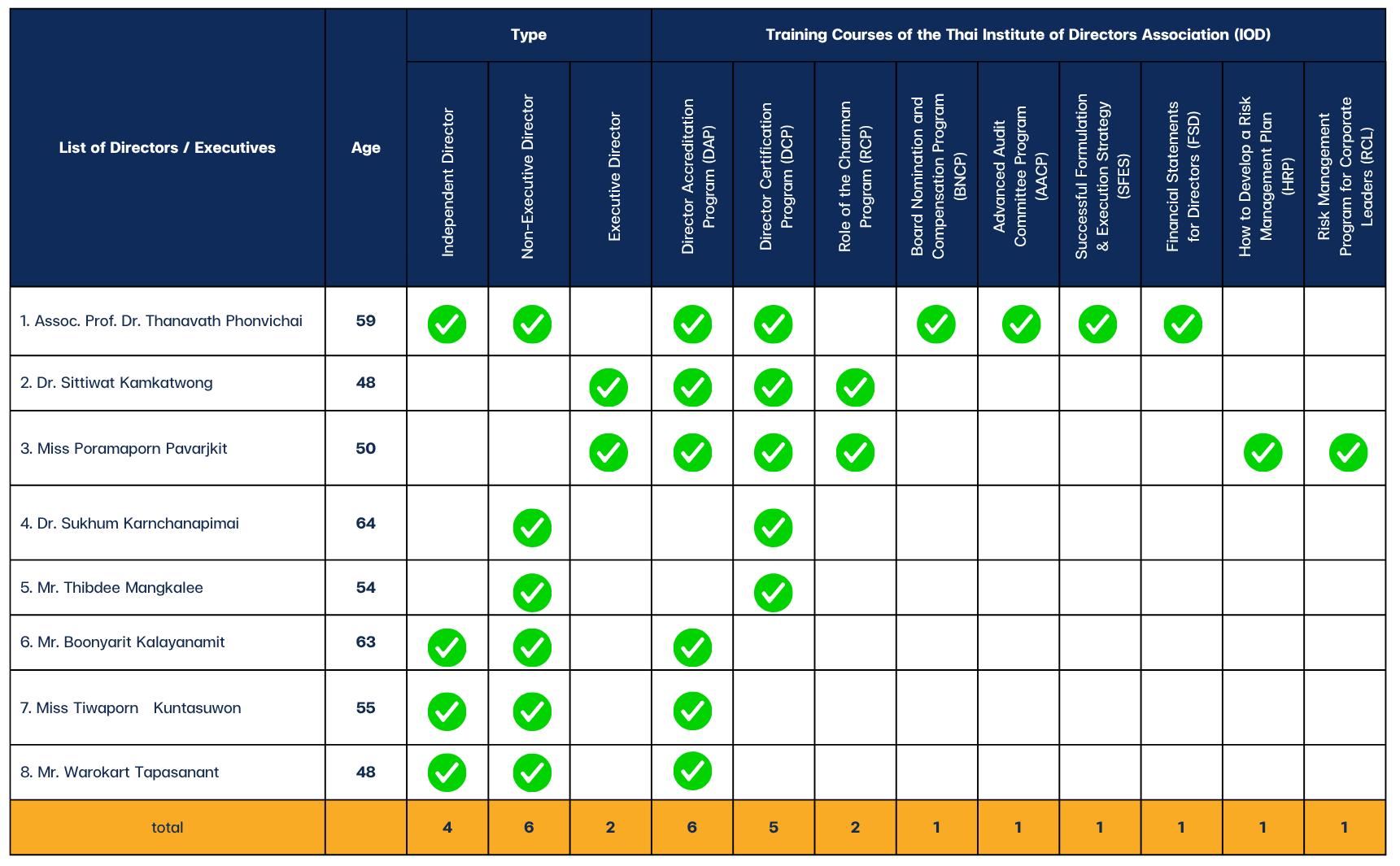
In addition, the Company has established a policy limiting the number of directorships held by its directors in other listed companies. Under this policy, each director may hold directorships in no more than five listed companies, to ensure that directors can allocate sufficient time and devote adequate attention to performing their duties effectively. This enables the Board to continuously oversee and monitor the Company's operations, thereby promoting accountability and enhancing the overall effectiveness of the Board of Directors in fulfilling its responsibilities.
Are Directors Selected Through the Nomination Committee?
Yes
Are Chief Executives Selected Through the Nomination Committee?
Yes
Rights of Minority Shareholders on Director Appointment
The Company places great importance on protecting shareholders' rights and ensuring equitable treatment of all shareholders. Accordingly, the Company has established a policy that provides shareholders with the opportunity to propose matters for inclusion in the agenda of the Annual General Meeting of Shareholders (AGM) and to nominate suitably qualified candidates for consideration and election as members of the Board of Directors.
In addition, shareholders are entitled to submit questions in advance regarding the Company's business operations or matters related to the meeting agenda. This allows the Board of Directors and management to review the questions and prepare comprehensive and appropriate information and explanations. These practices aim to encourage shareholder participation and support the Company's commitment to good corporate governance principles.
The Company has established clear criteria, conditions, and procedures for exercising these rights. Relevant information is publicly disclosed through the Company's website at www.imhhospital.com, under the Investor Relations section,
as well as through the information disclosure system of the Stock Exchange of Thailand (SET). This ensures that shareholders and investors have equal access to relevant information and are able to exercise their rights in accordance with the prescribed criteria and procedures.
The details are as follows:
Shareholders’ Rights to Propose Additional Meeting Agenda Items, Nominate Candidates for Election as Directors, and Submit Questions in Advance of the 2025 Annual General Meeting of Shareholders | ||
Annual General Meeting of Shareholders Schedule Date: April 28, 2025 Meeting Format: Physical Meeting (In-Person Meeting) | Period for Shareholders to Propose Additional Meeting Agenda Items and Nominate Candidates for Election as Directors November 13, 2024 – February 14, 2025 | Period for Shareholders to Submit Questions in Advance of the Meeting November 13, 2024 – February 14, 2025 |
Note: In 2025, no shareholders proposed additional agenda items, nominated candidates for election to the Board of Directors, or submitted questions in advance of the 2025 Annual General Meeting of Shareholders, in accordance with the criteria and timeframe established by the Company.
For the 2026 Annual General Meeting of Shareholders (AGM), the Company provided shareholders with the opportunity to exercise their rights to propose additional matters for inclusion in the meeting agenda, nominate suitably qualified candidates for election to the Board of Directors, and submit questions in advance regarding the Company's business operations or matters related to the meeting agenda. The period for exercising these rights was November 11, 2025, to February 13, 2026.
The Company has established clear voting procedures and vote-counting methods for shareholders' meetings. Ballot papers are provided for all agenda items, and shareholders are entitled to vote on the election of directors on an individual basis. These procedures are designed to ensure that voting and decision-making processes are conducted independently, transparently, and equitably, while enabling the accuracy of voting results to be verified.
The Company conducts its Annual General Meeting of Shareholders in the form of a Physical Meeting (In-Person Meeting). A barcode system is utilized for shareholder registration and verification of meeting attendance and voting rights, together with information technology systems for vote counting and processing. These systems enhance operational efficiency and accuracy, facilitate shareholder participation, and enable the voting results for each agenda item to be promptly and clearly announced to the meeting. Such practices reflect the Company's commitment to promoting and protecting shareholders' rights in accordance with good corporate governance principles.
Method of Director Appointment
| Method |
|---|
| Method whereby each director requires approval votes more than half of the votes of attending shareholders with voting rights |
Selection of Independent Directors
Criteria for Selecting Independent Directors
Independent Directors
The Company places great importance on good corporate governance and requires its Independent Directors to possess all qualifications prescribed by the rules and regulations of the Securities and Exchange Commission (SEC) and the Stock Exchange of Thailand (SET). Independent Directors must be independent of the Company's major shareholders, executives, and management, and must not have any relationships or interests that could impair their ability to exercise independent judgment in performing their duties and responsibilities. In this regard, Independent Directors must have sufficient access to the Company's financial information, business operations, and other relevant information to enable them to make informed decisions and express their opinions independently and impartially, while taking into consideration the best interests of the Company and all shareholders on an equitable basis, particularly the protection of the rights and interests of minority shareholders. Independent Directors are also expected to attend Board of Directors' meetings regularly to ensure effective oversight and monitoring of the Company's operations. Furthermore, upon appointment, Independent Directors are required to provide written certification confirming their qualifications and independence, as well as disclose relevant information concerning their independence in the Company's Annual Report in accordance with applicable rules and regulations. These practices aim to promote transparency and strengthen the confidence of shareholders and all stakeholders.
The Company requires that Independent Directors constitute at least one-third of the total number of directors, with a minimum of three Independent Directors, to ensure an appropriate Board composition and an effective balance of power in management and decision-making. As of December 31, 2025, the Company's Board of Directors comprised a total of eight directors, of whom four were Independent Directors, representing 50 percent of the total Board members. This proportion complies with the requirements prescribed by the relevant regulatory authorities and reflects the Company's commitment to promoting Board independence, transparent and fair corporate governance, and maintaining the confidence and protecting the interests of all shareholders on an equitable basis.
The Company has established the qualifications and independence criteria for Independent Directors in accordance with the requirements prescribed by the Securities and Exchange Commission (SEC) and the Stock Exchange of Thailand (SET), to ensure that they perform their duties independently, transparently, and impartially, while taking into consideration the best interests of the Company and all shareholders on an equitable basis. The qualifications and independence criteria are detailed as follows:
1. Holds no more than 1% of the total voting shares of the company, parent company, subsidiary, affiliate, major shareholder, or controlling person, including shares held by related persons.
2. Is not, and has not been, an executive director, employee, staff, salaried advisor, or controlling person of the company, parent company, subsidiary, affiliate, major shareholder, or controlling person unless such status ended not less than two years prior to the appointment.
3. Has no familial relationship (by blood or legal registration) such as parent, spouse, sibling, child, or spouse of child with any executive, major shareholder, controlling person, or person nominated as executive or controlling person of the company or subsidiary.
4. Has no business relationship with the company or related parties that may interfere with independent judgment and is not, nor has been, a significant shareholder or controlling person of any party with material business relations with the company unless such relationship ended at least two years prior.
5. Is not, and has not been, an auditor of the company or its related entities, nor a significant shareholder, controlling person, or partner of the auditing firm, unless the relationship ended at least two years prior.
6. Is not, and has not been, a professional service provider (e.g., legal or financial advisor) who receives fees exceeding 2 million baht per year from the company or related parties, and is not a significant shareholder, controlling person, or partner of such provider, unless the relationship ended at least two years prior.
7. Is not a director nominated as a representative of other directors, major shareholders, or related shareholders.
8. Does not operate a business that is materially similar or competitive with the company or subsidiary, nor holds more than 1% of voting shares, or serves as an executive, employee, or advisor receiving salary from such competing business.
9. Has no other characteristics that would affect the ability to express independent opinions regarding the company’s operations.
10. Is not a director assigned by the board to make decisions on business operations of the company or its related entities.
11. Is not a director of any parent, subsidiary, or fellow subsidiary that is a listed company.
The Company stipulates that Independent Directors shall serve for a maximum consecutive term of nine years, commencing from the date of their initial appointment as Independent Directors. However, if the Board of Directors determines that an Independent Director continues to possess the qualifications, knowledge, skills, and experience beneficial to the Company's operations, and remains capable of performing their duties independently and effectively, the Board may consider proposing the continuation of such director's tenure beyond the nine-year limit. In such cases, the Board of Directors shall provide appropriate justification and clearly explain the reasons and necessity to the shareholders' meeting for consideration and approval of the reappointment of the Independent Director for a further term.
Did Any Independent Director Have a Business or Professional Relationship?
No
Director Development
Qualifications for Director Selection
| Qualification | Skill & Expertise |
|---|---|
| Medical Expertise | 134 · Description: Health Care Services |
| Leadership | 163 · Description: Leadership · 164 · Description: Strategic Management · 265 · Description: Governance/ Compliance · 158 · Description: Corporate Management |
| Management | 1683 · Description: Business Administration · 164 · Description: Strategic Management · 158 · Description: Corporate Management · 157 · Description: Project Management · 152 · Description: Data Analysis |
| Financial | 112 · Description: Economics · 118 · Description: Banking · 119 · Description: Finance & Securities · 144 · Description: Finance · 149 · Description: Fund Management |
| Accounting | 143 · Description: Accounting · 144 · Description: Finance · 153 · Description: Statistics · 152 · Description: Data Analysis |
| Legal | 141 · Description: Law · 265 · Description: Governance/ Compliance |
| Organizational development | 134 · Description: Health Care Services · 158 · Description: Corporate Management · 164 · Description: Strategic Management · 165 · Description: Risk Management · 1683 · Description: Business Administration |
| Social Aspect | 145 · Description: Corporate Social Responsibility · 147 · Description: Sustainability |
| Information Technology | 150 · Description: IT Management · 140 · Description: Information & Communication Technology · 151 · Description: Data Management |
| Commercial Side | 133 · Description: Commerce · 112 · Description: Economics · 142 · Description: Marketing · 154 · Description: Digital Marketing |
Evaluation of Board & Subcommittee Performance
Criteria for Evaluating Board Performance
IMH Hospital Group places great importance on the regular evaluation of the Board of Directors' performance as a tool to review, assess, and enhance the effectiveness of corporate governance. This ensures transparency, accountability, and long-term value creation for the organization.
The 2024 annual performance evaluation was conducted using the Board Self-Assessment, covering several key dimensions:
1. Roles and responsibilities
2. Board composition and structure
3. Meeting participation and engagement
4. Strategic oversight
5. Oversight of ethics, risk, and governance
6. Monitoring of management performance
7. Board-management relationships
Each director performed a self-assessment based on the predefined criteria. The overall result for 2024 indicated that the Board’s performance was rated “Excellent”, with an average score of 4.00 out of 4.00, reflecting strong agreement or exceptional performance in all areas.
This result demonstrates the Board’s commitment, attentiveness, and accountability in fulfilling its duties professionally. It reflects the effective, transparent, and ethical governance of IMH Hospital Group, reinforcing confidence among shareholders and all stakeholders.
Evaluation of Board Performance in the Past Year
IMH Hospital Group places strong emphasis on conducting regular and systematic evaluations of the Board of Directors' performance. This serves as a mechanism to enhance the effectiveness of corporate governance and as a tool to reflect transparency, accountability, and professionalism across all dimensions of the Board's responsibilities.
The Board performance evaluation is conducted through self-assessment, both at the Board as a whole level and individual director level. In some cases, specific assessments may also be carried out for the Chairman of the Board and the Chairmen of sub-committees, ensuring all aspects of their roles and responsibilities are comprehensively reviewed.
The results of the evaluations are compiled, analyzed, and summarized to be presented to the Board. These insights are then utilized as a basis for enhancing Board capabilities, including planning for training and the development of essential skills that support effective corporate governance in response to evolving industry and economic contexts.
This process reflects IMH Hospital Group’s commitment to continuously elevate the standards and effectiveness of its Board of Directors in alignment with international best practices in corporate governance.
Evaluation Results
| Evaluated Body | Group — Carried Out? | Group — Grade / Average Score | Group — Grade / Full Score | Individual (Self-Assessment) — Carried Out? | Individual (Self-Assessment) — Grade / Average Score | Individual (Self-Assessment) — Grade / Full Score | Cross (Assessing Other Directors) — Carried Out? |
|---|---|---|---|---|---|---|---|
| Audit Committee | Y | Excellent | Excellent | Y | Excellent | Excellent | N |
| Other Subcommittee | Y | Excellent | Excellent | Y | Excellent | Excellent | N |
| Board Of Director | Y | Excellent | Excellent | Y | Excellent | Excellent | N |
| Executive Committee | Y | Excellent | Excellent | Y | Excellent | Excellent | N |
| Other Subcommittee | Y | Excellent | Excellent | Y | Excellent | Excellent | N |
| Other Subcommittee | Y | Excellent | Excellent | Y | Excellent | Excellent | N |
| Other Subcommittee | Y | Excellent | Excellent | Y | Excellent | Excellent | N |
Subcommittees
Subcommittees
| Results of the Subcommittee's Duty Performance |
|---|
In 2025, the Nomination and Remuneration Committee performed its duties within the scope of authority delegated by the Board of Directors, with a focus on ensuring that the appointment of senior executives and the remuneration framework were appropriate, transparent, and aligned with the Company’s strategic direction and good corporate governance principles. The Committee’s key activities during the year are summarized as follows: 1) Nomination and Appointment of Directors and Senior ExecutivesThe Committee reviewed the qualifications, suitability, and independence of directors and senior executives in accordance with established criteria, and oversaw succession-planning processes to ensure leadership continuity. Proposed candidates were submitted to the Board of Directors for approval or to the shareholders’ meeting, as appropriate. 2) Review of Remuneration StructureThe Committee reviewed remuneration policies and structures for directors and senior executives to ensure alignment with performance, scope of responsibilities, business conditions, and market practices among peer listed companies, before submitting recommendations to the Board of Directors or the shareholders’ meeting for approval. 3) Linking Remuneration to PerformanceThe Committee established remuneration-assessment criteria linked to corporate performance, financial metrics, and service-quality and sustainability indicators, in order to support the Company’s long-term business objectives. 4) Performance Evaluation of Senior ManagementIn collaboration with the Board of Directors, the Committee reviewed the performance-evaluation results of the Chief Executive Officer and senior executives against predetermined criteria. These results were used as inputs for remuneration decisions and executive-development initiatives. 5) Governance and Transparency OversightThe Committee ensured that nomination and remuneration processes were conducted fairly, transparently, and without conflicts of interest, and monitored the disclosure of relevant information in the Annual Report in accordance with regulatory requirements. |
In 2025, the Corporate Governance Working Group performed its duties as assigned by the Board of Directors, with a focus on strengthening good corporate governance systems, transparency, legal compliance, and business ethics, as well as elevating governance standards at all levels of the organization. Key activities during the year are summarized as follows: 1) Monitoring Compliance with Corporate Governance PrinciplesThe Working Group reviewed and monitored the operations of relevant departments to ensure compliance with the Company’s corporate governance policies, Code of Conduct, and regulatory requirements. Observations and recommendations for improvement were submitted to management and the Board of Directors. 2) Review and Enhancement of Governance-Related PoliciesThe Working Group participated in the review and revision of key governance policies, including the Code of Conduct, anti-corruption policy, conflict-of-interest management guidelines, and whistleblowing procedures, to ensure alignment with evolving business conditions and regulatory expectations. 3) Promotion of a Governance-Driven Corporate CultureThe Working Group supported internal communications and training programs for directors, executives, and employees to raise awareness of ethical conduct, transparency, and accountability toward stakeholders. 4) Monitoring Complaints and Anti-Corruption MeasuresThe Working Group monitored complaint-handling processes and investigations involving alleged misconduct, corruption, or policy violations, coordinated with relevant functions, and reported findings to the Board of Directors through established governance channels. 5) Support for Disclosure and External AssessmentsThe Working Group supported the preparation of corporate-governance disclosures for the Annual Report, CGR and AGM Checklist assessments, and Stock Exchange filings, in order to reflect the Company’s transparency and governance standards. |
In 2025, the Risk Management Working Group performed its duties as assigned by the Board of Directors, with a focus on strengthening the enterprise-wide risk-management framework in a systematic and transparent manner, aligned with the Company’s business strategy, in order to support organizational resilience and sustainable growth. Key activities during the year are summarized as follows: 1) Enterprise Risk Review and AssessmentThe Working Group collected, analyzed, and prioritized material risks across strategic, operational, financial, compliance, and ESG dimensions. The Risk Register was reviewed and the results were submitted to the Risk Management Committee and the Board of Directors, respectively. 2) Monitoring Risk-Mitigation Plans and Control MeasuresThe Working Group continuously monitored the progress of risk-mitigation plans implemented by relevant departments, assessed the effectiveness of internal-control mechanisms, and proposed enhancements in response to changing circumstances. 3) Integration of Risk Management with Strategy and Business PlanningThe Working Group supported alignment between risk management and corporate strategy, investment decisions, and medical-service expansion by embedding risk considerations into management-level decision-making processes. 4) Oversight of Business Continuity and Emergency PreparednessThe Working Group monitored the development and testing of Business Continuity and Crisis-Management Plans (BCP/BCM) across hospitals within the Group to strengthen operational readiness for events that could affect service delivery. 5) Promotion of a Risk-Aware CultureThe Working Group supported internal training and communication initiatives to raise awareness of risk management among executives and employees, and encouraged appropriate incident and risk reporting throughout the organization. 6) Reporting and DisclosureThe Working Group prepared regular risk-management reports for submission to the Risk Management Committee and the Board of Directors, and supported the preparation of risk-management disclosures for inclusion in the Annual Report in accordance with regulatory requirements. |
In 2025, the Corporate Social Responsibility Working Group carried out its duties as assigned by the Board of Directors, with a focus on promoting responsible business conduct toward society, communities, and stakeholders, while supporting the Company’s sustainable-development objectives. Key activities during the year are summarized as follows: 1) CSR Strategy and PlanningThe Working Group collaborated in developing and monitoring CSR action plans aligned with corporate strategy and the local contexts surrounding the Group’s hospitals, including prioritization of social issues relevant to business operations. 2) Implementation of Community and Social ProjectsThe Working Group supported and monitored projects such as community-health promotion, preventive medical services, assistance for vulnerable groups, educational support, and employee-volunteer initiatives, in order to deliver tangible social benefits. 3) Stakeholder EngagementThe Working Group promoted communication and dialogue with communities, local authorities, business partners, and external organizations to ensure that CSR initiatives addressed stakeholder needs and strengthened long-term relationships. 4) Monitoring and Impact AssessmentThe Working Group established processes to monitor and evaluate CSR activities in terms of beneficiary numbers, community satisfaction, and social outcomes, and used the findings to enhance future program effectiveness. 5) Communication and DisclosureThe Working Group supported the preparation and disclosure of CSR performance information in the Annual Report and through corporate communication channels, demonstrating transparency and the Company’s commitment to sustainable social development. |
Meeting Attendance & Remuneration
Justification for Directors' Non-Attendance
Mr. Boonyarit Kalayanamit informed the Company of his inability to attend the Board of Directors’ Meeting No. 3/2025 held on May 13, 2025 due to a prior important commitment.
Types of Remuneration of the Board of Directors
The Company has established a policy for determining directors’ remuneration in accordance with good corporate-governance practices. In setting such remuneration, the Company takes into account the directors’ duties, responsibilities, dedication, and the value expected from their performance, benchmarked against other listed companies in the Stock Exchange and those operating in the same or similar industries. Consideration is also given to the Company’s sustained operating performance and prevailing economic conditions.
For 2025, the Nomination and Remuneration Committee reviewed and proposed that directors’ remuneration be provided in the form of monthly fees and meeting allowances, with an aggregate amount not exceeding THB 3,500,000, which is unchanged from the previous year, and with no additional benefits provided.
Remuneration or Benefits Payable to the Board
| Metric | Amount (Baht) |
|---|---|
| Remunerations or benefits pending payment to the board of directors over the past year (baht) | 0 |
Supervision of Subsidiaries & Associated Companies
Does the Company Have Subsidiaries or Associated Companies?
Yes
Is There a Mechanism for Overseeing Subsidiaries and Associated Companies?
Yes
Mechanism for Overseeing Management of Subsidiaries
The Company places importance on appropriately supervising the operations of its subsidiaries and associates in proportion to its shareholdings by establishing governance structures, reporting processes, and internal-control systems to ensure that business operations are aligned with the Company’s policies and conducted in compliance with laws and good-governance principles.
Key oversight mechanisms include the following:
1. Appointment of Representatives as Directors or Executives
The Company considers appointing its representatives to serve as directors or executives of subsidiaries and associates in accordance with its shareholding ratio and level of managerial influence, in order to oversee operations and appropriately reflect the Company’s policies in such entities.
2. Definition of Authority and Responsibilities
The Company clearly defines the roles, duties, and authority of directors and executives who represent the Company in subsidiaries and associates, particularly in relation to key policies, investments, risk management, and legal compliance. Such representatives are required to regularly report operational performance to the Company.
3. Disclosure of Financial Position and Operating Results
Subsidiaries and associates are required to submit reports on their financial position and operating performance to the Company on a periodic basis for monitoring purposes, preparation of consolidated financial statements, and accurate and complete disclosure to the Stock Exchange.
4. Related-Party Transactions
The Company requires that transactions between the Company, its subsidiaries or associates, and related parties be conducted in accordance with regulatory requirements, approved by the relevant committees or the Board, and disclosed transparently.
5. Other Significant Transactions
Transactions that may materially affect the financial position or operations of subsidiaries and associates—such as entering into long-term contracts, incurring indebtedness, or joint investments—must be proposed to the Company for consideration within the prescribed approval authority framework to ensure appropriate oversight.
6. Acquisition or Disposal of Assets
Material acquisitions or disposals of assets by subsidiaries must undergo the approval process in accordance with the Company’s delegated authority and the regulations applicable to listed companies, and be reported to the Board of Directors as appropriate.
7. Internal-Control Systems of Principal Subsidiaries
The Company requires subsidiaries that conduct principal businesses to maintain adequate and appropriate internal-control systems covering financial reporting, operations, legal compliance, and risk management. The Company’s internal-audit function periodically reviews such systems and reports its findings to the Audit Committee for continuous improvement.
Oversight Mechanisms
| Mechanism |
|---|
| Sending representatives to act as directors, executives or controlling persons in proportion to shareholdings |
| Defining the scope of powers, duties and responsibilities of directors and executives who represent the company in setting important policies |
| Disclosure of financial information and operating results |
| Transactions between the Company and related persons |
| Other important transactions |
| Acquisition or disposal of assets |
| Internal control system of the subsidiary operating the core business is appropriate and sufficient in the subsidiary operating the core business |
Board Duty Performance — Overview
Board Duty Performance — Overall Description
In 2025, the Board of Directors exercised prudent and principled corporate governance oversight to support the sustainable growth of the IMH Hospital Group, in compliance with applicable laws, regulatory requirements, and the Company’s internal policies. The Board emphasized long-term value creation for shareholders while giving due consideration to all stakeholder groups. Throughout the year, the Board deliberated on and oversaw the following key matters:
1. Corporate Direction and Strategy
The Board reviewed medium- and long-term business plans and strategic direction to ensure alignment with economic conditions and competitive dynamics in the hospital industry, including oversight of investment projects and service-expansion initiatives under appropriate risk-management frameworks.
2. Financial Oversight and Operating Performance
The Board regularly monitored the Company’s operating results and financial position through reports from management and the Audit Committee to ensure that operations proceeded in accordance with approved plans and that adequate internal-control systems were in place.
3. Risk Management and Internal Control
The Board emphasized enterprise risk management by considering key risk issues relating to business operations, clinical services, information technology, and ESG matters, and by continuously monitoring mitigation measures.
4. Corporate Governance and Ethics
The Board promoted business operations under good corporate governance principles, transparency, and ethical conduct through reviews of key policies, including the Code of Conduct, anti-corruption policy, and sustainability policies. Compliance with applicable laws and Stock Exchange regulations was also closely monitored.
5. Stakeholder Engagement and ESG Matters
The Board oversaw environmental, social, and governance initiatives, with particular attention to patient safety, employee welfare, community engagement, and personal-data protection, in order to strengthen long-term stakeholder confidence.
6. Board Performance Evaluation and Development
During 2025, the Board conducted performance evaluations of both the Board as a whole and individual directors. The results were used to enhance governance processes and continuously improve the effectiveness of Board oversight.
Audit Committee Duty Performance
Results of the Audit Committee's Duty Performance in the Past Year
In 2025, the Audit Committee fully performed its duties as delegated by the Board of Directors in accordance with applicable laws and regulatory requirements, with a focus on strengthening confidence in the Company’s corporate-governance framework, financial reporting, and internal-control systems to support the stable and sustainable operations of the IMH Hospital Group.
During the year, the Audit Committee exercised oversight in the following key areas:
1. Oversight of Financial Reporting
The Audit Committee reviewed the quarterly and annual financial statements together with management and the external auditor to ensure that the financial reports were prepared accurately, completely, and in accordance with applicable financial-reporting standards, with appropriate disclosures.
2. Oversight of Internal Control and Internal Audit
The Audit Committee monitored the effectiveness of the internal-control system and internal-audit processes by reviewing reports from the internal-audit function on audit findings, corrective actions, and improvements to key processes, in order to ensure that internal controls remained appropriate for the Company’s business operations and risk profile.
3. Oversight of Legal and Regulatory Compliance
The Audit Committee monitored compliance with laws, rules, and regulatory requirements applicable to hospital operations and listed companies, including the handling of complaints or observations raised by external authorities, to ensure transparent and lawful business conduct.
4. Oversight of External Auditors
The Audit Committee considered the appointment, remuneration, and audit scope of the external auditors and held meetings with them, where appropriate, without management present in order to preserve auditor independence and audit effectiveness.
5. Review of Governance and Ethics Policies
The Audit Committee participated in the review of key governance-related policies, including the anti-corruption policy, whistleblowing procedures, and corporate-governance guidelines, to ensure alignment with best practices and Stock Exchange requirements.
Executive Committee Duty Performance
Results of the Executive Committee's Duty Performance in the Past Year
In 2025, the Executive Committee performed its duties within the scope of authority delegated by the Board of Directors, with a focus on strategic oversight, monitoring operational performance, and enterprise risk management to support the sustainable growth of the IMH Hospital Group. Key areas of oversight during the year are summarized as follows:
1) Strategic Direction and Business Planning
The Executive Committee reviewed and scrutinized the annual business plan, budget, and major investment projects prior to submission to the Board of Directors for approval. The Committee also monitored progress on strategic initiatives, service expansion, and the development of medical technology capabilities to ensure alignment with the Company’s objectives.
2) Monitoring of Operating Performance
The Executive Committee regularly received operational performance reports from management and provided policy-level guidance on revenue, cost management, operating efficiency, service quality, and patient satisfaction, with the aim of strengthening overall management standards.
3) Risk Management and Internal Control
The Executive Committee oversaw enterprise-wide risk management, internal control systems, and business continuity planning. It also monitored key risk issues, including medical-personnel shortages, information security and cybersecurity, and regulatory and legal compliance readiness.
4) Corporate Governance and Sustainability Oversight
The Executive Committee emphasized good corporate governance, business ethics, and ESG performance by tracking progress on environmental, social, and governance initiatives, as well as ensuring appropriate engagement with stakeholders.
5) Review of Key Projects and Material Matters
During the year, the Executive Committee considered significant business matters, including:
Upgrading and enhancing the capabilities of hospitals within the Group
Investment in medical equipment and advanced technologies
Development of digital and information systems
Human-resource management and workforce-development plans
Preparations for regulatory compliance and disclosure requirements