MD&A · 2025
In this section4 topics
Overview of Operations
Overview of Operations
This section presents the Management Discussion and Analysis (MD&A) of the Company’s financial position and operating results for the year ended 31 December 2025. It has been prepared by the Company’s management to reflect an overview of operating performance, financial position, as well as an assessment of key factors that may affect the Company’s future business opportunities and performance.
This analysis should be read in conjunction with the Company’s financial statements and the notes to the financial statements, together with other relevant information disclosed in this Annual Report, in order to provide a comprehensive and well-rounded understanding of the Company’s financial position and operating results. In presenting the information, management has rounded certain figures, including financial ratios expressed as percentages, for ease of presentation and clarity. Such rounding does not have a material impact on the substance of the information presented.
The Company’s financial statements for the year ended 31 December 2025 have been audited by Ms. Soraya Tintasuwan, Certified Public Accountant (Registration No. 8658) of Dharmniti Auditing Co., Ltd., an independent auditor, who has expressed an opinion on such financial statements in accordance with generally accepted auditing standards.
Operating Results & Financial Condition
Operating Results & Profitability
Intermedical Care and Lab Hospital Public Company Limited (the “Company”) hereby submits the Management Discussion and Analysis (MD&A) of the Company’s consolidated financial statements for the year 2025, summarized as follows:
1. Operating Performance
The Company reported earnings before finance costs, depreciation, income tax expenses, and accounting provisions of Baht 22.90 million. During the second quarter of 2025, two subsidiaries, namely Accu Fast Lab Center Co., Ltd. (IMH Thonburi Hospital) and IMH Silom Hospital Co., Ltd. (IMH Silom Hospital), registered as primary care units and contracted service units to provide healthcare services under the Universal Coverage Scheme (UCS) in accordance with government policy. This resulted in increased operating costs for the hospitals.
Subsequently, IMH Thonburi Hospital withdrew from its status as a primary care and contracted service unit and remained only as a referral hospital. As a result, hospital costs have not yet fully adjusted to reflect the change in business model, leaving certain accounting costs still outstanding.
2. Non-Cash Items
The Company recorded non-cash items in accordance with accounting standards, including depreciation amounting to Baht 55.81 million, and depreciation of right-of-use assets (land lease) totaling Baht 15.42 million. In addition, the Company recorded an allowance for doubtful accounts of Baht 88 million arising from medical service claims to the National Health Security Office (NHSO) in prior periods.
However, the Company continues to follow up on such receivables with the NHSO. The recognition of these provisions does not have any impact on the normal operations of the hospitals.
3. Restatement of Financial Statements
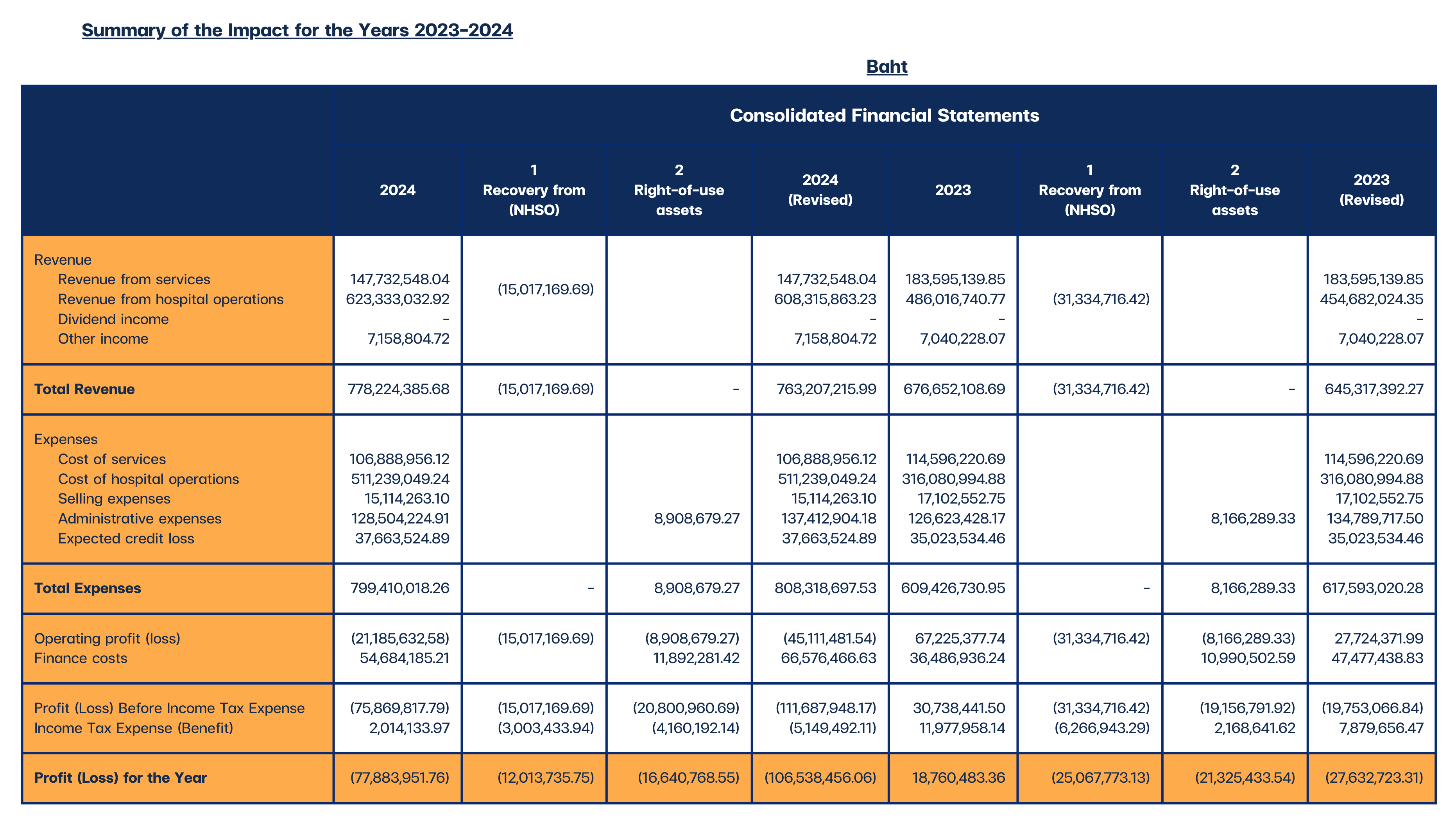
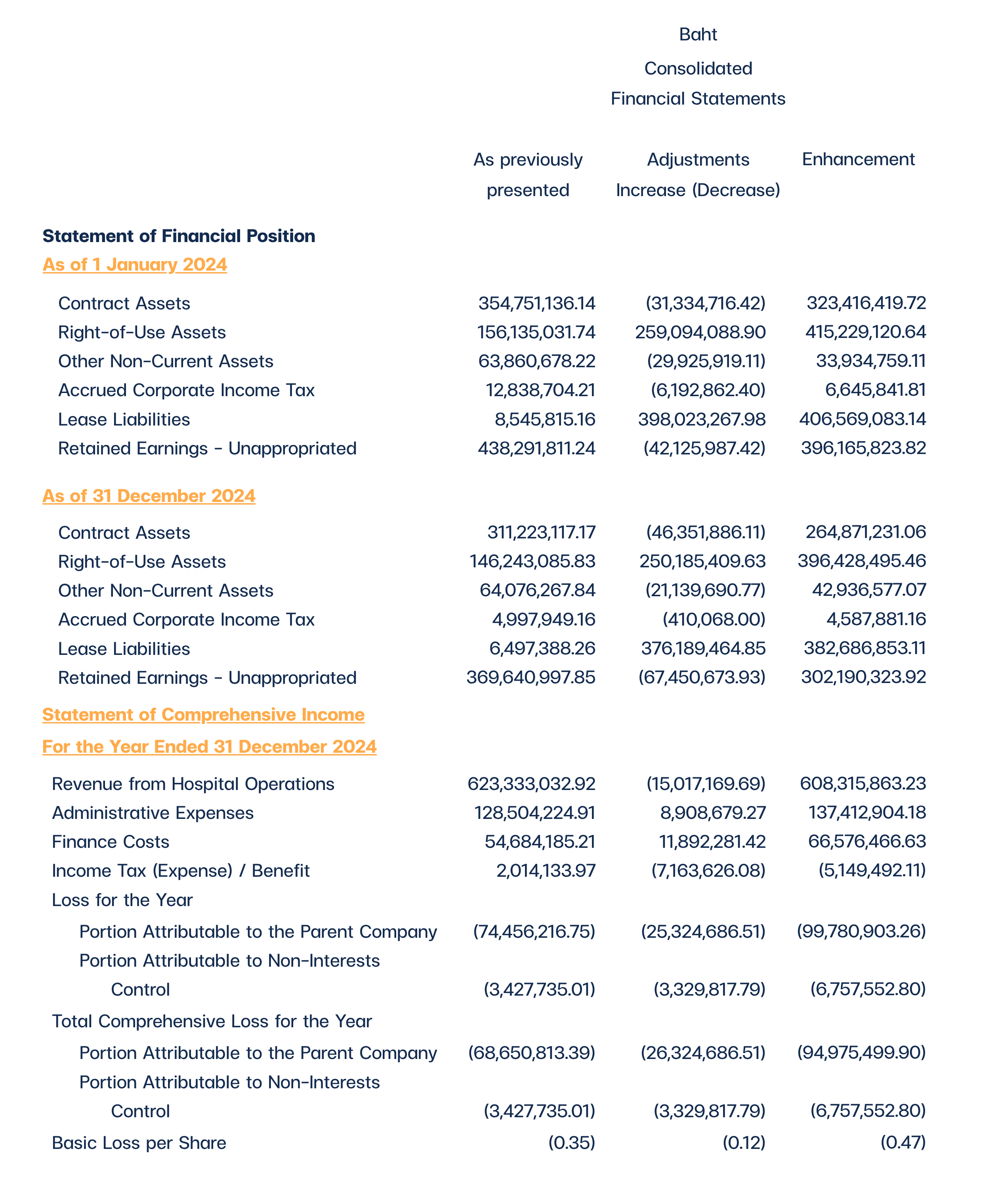
During 2025, a subsidiary recorded provisions related to medical service revenues from the National Health Security Office and did not recognize certain land lease agreements, as the Company had entered into an agreement with the lessor to extend the lease term.
As a result, the subsidiary restated its financial statements retrospectively, which affected the consolidated statements of financial position as at 1 January 2024 and 31 December 2024, as well as the consolidated statement of comprehensive income for the year ended 31 December 2024. The summary of such impacts is as follows:
Outlook for 2026
The Company aims to expand its customer base across Social Security, life insurance, and self-paying (cash) segments. It will enhance its capabilities by strengthening its team of specialist physicians, particularly those from government hospitals, and upgrading medical equipment to support the treatment of more complex conditions. The Company seeks to position itself as a leading hospital capable of serving patients under all healthcare schemes, while reducing referral costs to higher-capability hospitals.
Marketing Plan
Expand the number of specialized medical professionals from medical schools to accommodate the increasing volume of outpatient cases
Conduct marketing activities within workplaces in target areas to increase the number of Social Security beneficiaries
Launch promotional campaigns to encourage patients to access Social Security benefits
Promote the 14-item free health check-up program under the Social Security scheme to support the transfer of Social Security entitlements and increase additional services beyond the free benefits
Promote annual health check-up and aesthetic (wellness) services at special prices to increase revenue from cash-paying customers
Expand partnerships with life insurance agents to grow the life insurance customer base
Promote healthcare services for migrant workers who purchase private insurance through agents
Revenue
Service Revenue
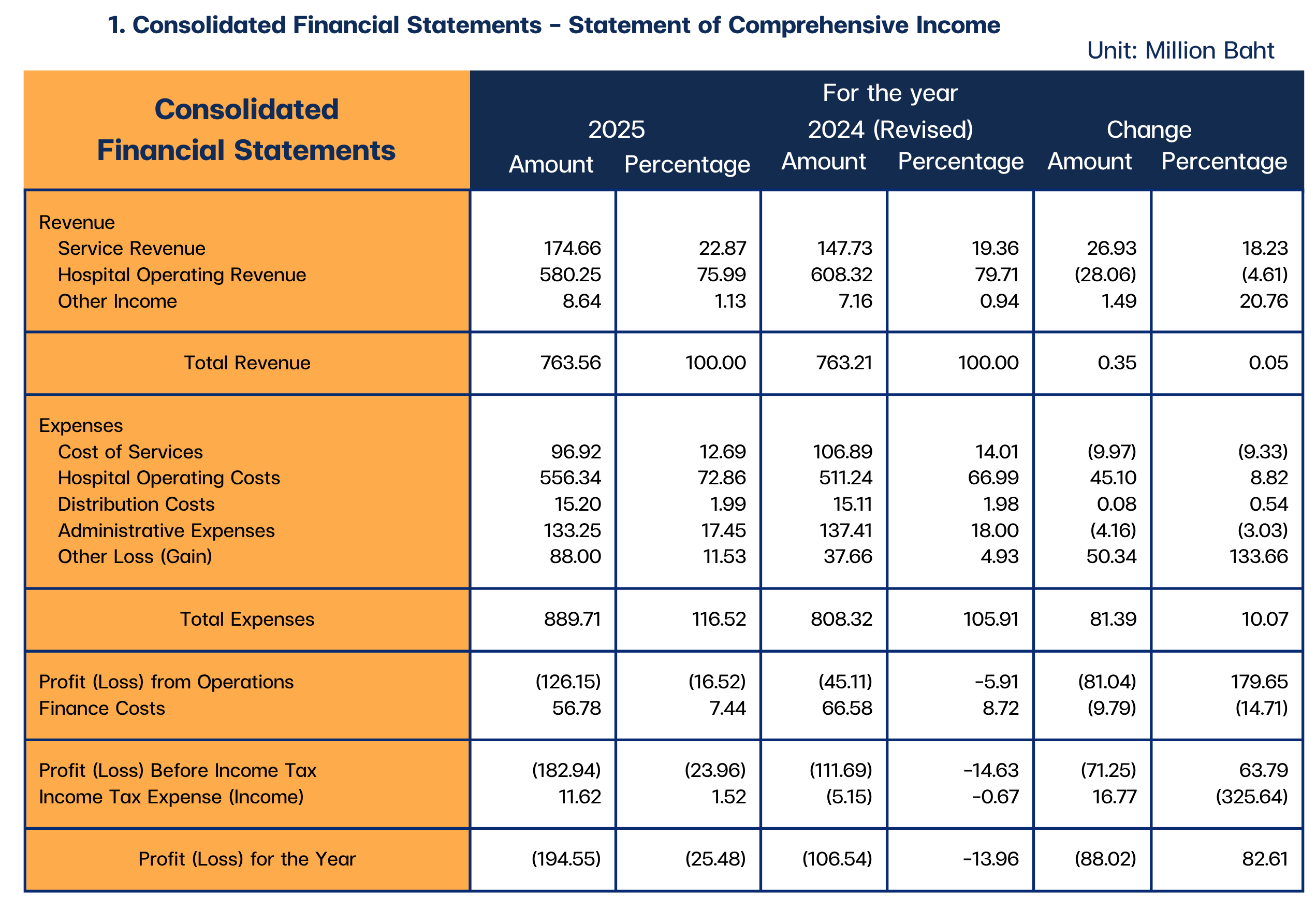
In 2025, total service revenue amounted to Baht 754.91 million (net of intercompany transactions), comprising Baht 174.66 million from medical service revenue and Baht 580.25 million from hospital operations.
Medical Service Revenue
In 2025, medical service revenue totaled Baht 174.66 million, representing an increase of Baht 26.93 million, or 18.23%, from Baht 147.73 million. The increase was primarily attributable to revenue from health check-ups for migrant workers for registration with the Department of Employment, which amounted to Baht 38.12 million, compared to Baht 0.48 million in 2024.
Hospital Operations Revenue
In 2025, revenue from hospital operations totaled Baht 580.25 million, representing a decrease of Baht 28.06 million, or 4.61%, from Baht 608.32 million. This decline was mainly due to the reimbursement policy of the National Health Security Office (NHSO) for primary care units and contracted service units, which provides a capitation rate of Baht 90–100 per person per month (depending on age group). As a result, the average outpatient revenue per visit decreased.
Other Income
In the third quarter of 2025, the Company recorded other income of Baht 8.64 million, an increase of Baht 1.49 million, or 20.76%, from Baht 7.16 million. This consisted mainly of interest income, gains from disposal of assets, and revenue from food and beverage sales.
Cost of Services
In 2025, the Company’s cost of sales and services totaled Baht 653.26 million (net of intercompany transactions), comprising:
Cost of Medical Services
In 2025, cost of medical services amounted to Baht 96.92 million, representing a decrease of Baht 9.97 million, or 9.33%, from Baht 106.89 million. This was mainly due to the increase in revenue from migrant worker health check-ups, which carry lower service costs compared to other types of services.
Cost of Hospital Operations
In 2025, cost of hospital operations totaled Baht 556.34 million, representing an increase of Baht 45.10 million, or 8.82%, from Baht 511.24 million. This increase was primarily due to changes in government policy, which required subsidiaries to adjust their strategies in serving patients under the Universal Coverage Scheme. During the transition period, treatment costs remained high, as cost optimization requires time.
Selling and Administrative Expenses
In 2025, selling expenses amounted to Baht 15.20 million, representing a slight increase of 0.54% from Baht 15.11 million. Administrative expenses totaled Baht 133.25 million, representing a decrease of 3.03% from Baht 137.41 million.
Other Loss (Gain)
In 2025, the Company recorded other losses of Baht 88 million, an increase of Baht 50.34 million, or 133.66%, primarily due to the recognition of an allowance for doubtful accounts related to medical service receivables from the NHSO in prior periods.
Finance Costs
In 2025, finance costs totaled Baht 56.78 million, representing a decrease of Baht 9.79 million, or 14.71%, from Baht 66.58 million. This was mainly due to a reduction in interest rates during the year in line with the Monetary Policy Committee’s announcements.
Financial Position
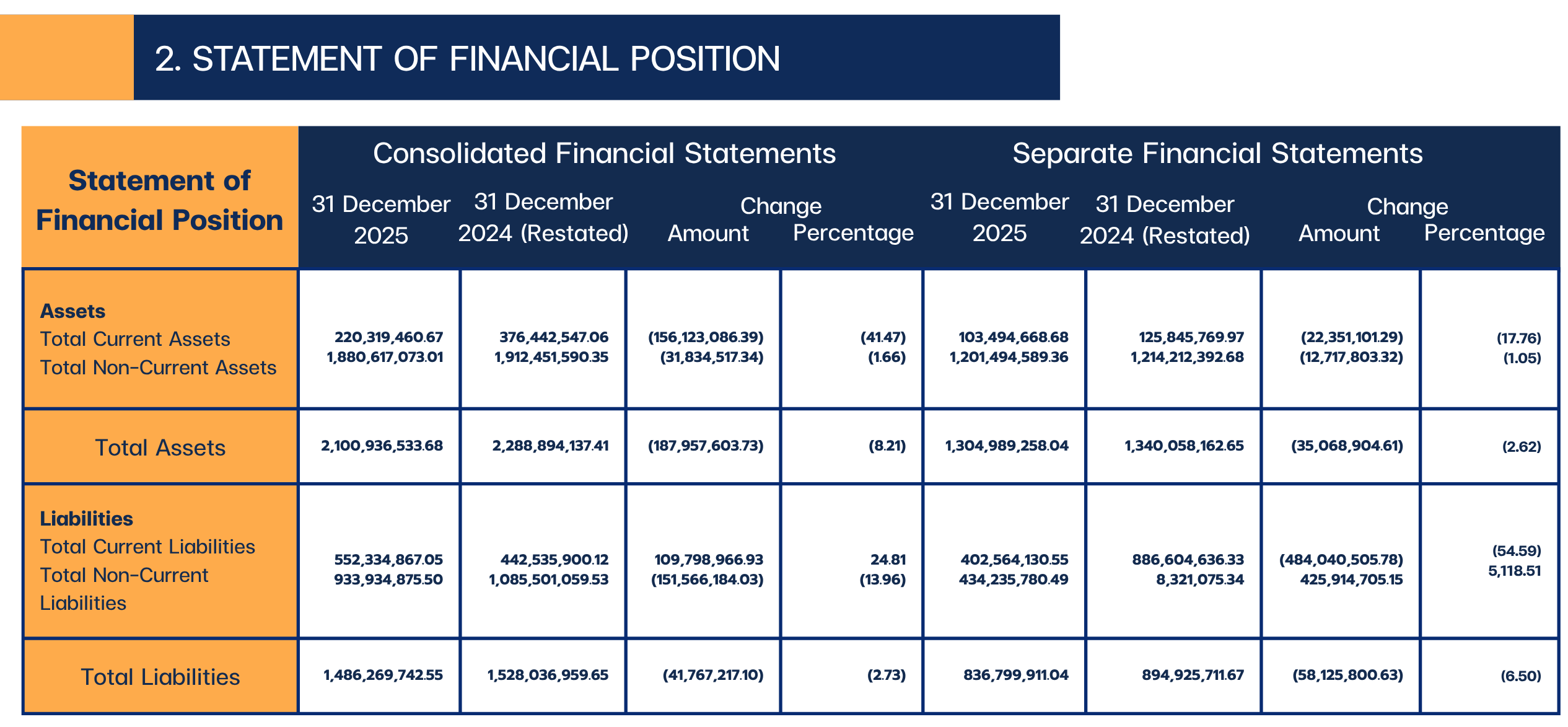
As at 31 December 2025, the Company’s consolidated financial statements reported total assets of Baht 2,100.94 million, representing a decrease of Baht 187.96 million from the previous year. Total liabilities amounted to Baht 1,486.27 million, a decrease of Baht 41.77 million from the previous year. The key changes in assets and liabilities are summarized as follows:
1. Trade and Other Current Receivables
Trade and other current receivables amounted to Baht 45.63 million, a decrease of Baht 22.65 million from the previous year. This was mainly due to increased revenue in the separate financial statements from migrant worker health check-ups, where customers are primarily corporate or private entities with timely payments. In addition, the Company has implemented a policy to closely monitor and report receivable aging on a weekly basis.
2. Contract Assets – Current
Contract assets (current) amounted to Baht 119.21 million, decreasing by Baht 145.66 million from the previous year. This was mainly due to the recognition of an allowance for doubtful accounts of Baht 88 million related to the National Health Security Office (NHSO) from prior periods, as well as a decline in outpatient capitation revenue under the Universal Coverage Scheme due to changes in government policy. In addition, there were no additional outstanding expenses in subsidiaries related to the Social Security Office.
3. Right-of-Use Assets
Right-of-use assets amounted to Baht 383.40 million, a decrease of Baht 13.02 million from the previous year, primarily due to depreciation of right-of-use assets related to land lease agreements for the IMH Bearing project.
4. Other Non-Current Assets
Other non-current assets amounted to Baht 32.81 million, decreasing by Baht 10.12 million from the previous year, mainly due to the return of performance guarantees related to medical service contracts during 2025.
5. Trade and Other Current Payables
Trade and other current payables amounted to Baht 283.11 million, an increase of Baht 88.68 million from the previous year. This was primarily due to the Company negotiating extended credit terms with suppliers to align with the timing of payments received from government agencies.
6. Lease Liabilities
Lease liabilities due within one year amounted to Baht 110.89 million, increasing by Baht 55.45 million from the previous year. Lease liabilities due beyond one year, classified as non-current liabilities, amounted to Baht 332.36 million, decreasing by Baht 38.43 million. These changes were mainly related to lease agreements for right-of-use assets associated with the IMH Bearing land lease.
7. Short-Term Loans from Financial Institutions
Short-term loans from financial institutions due within one year amounted to Baht 100.17 million, decreasing by Baht 504.55 million from the previous year. Meanwhile, long-term loans (non-current portion) amounted to Baht 482.28 million, increasing by Baht 409.92 million from the previous year.
This was primarily because, in 2024, the Company was unable to maintain certain financial covenants, including debt service coverage ratio and debt-to-equity ratio, as required under loan agreements. However, on 17 December 2025, the Company obtained a waiver of such financial covenants from the lending bank, resulting in a reclassification of loan repayments. During 2025, the Company repaid loans totaling Baht 94.63 million.
8. Other Non-Current Liabilities
In 2025, there were no other non-current liabilities, as a subsidiary, Mahesak Hospital Co., Ltd., offset outstanding medical service receivables from the Social Security Office against amounts payable that had previously been withheld.
Hospital Business Risk
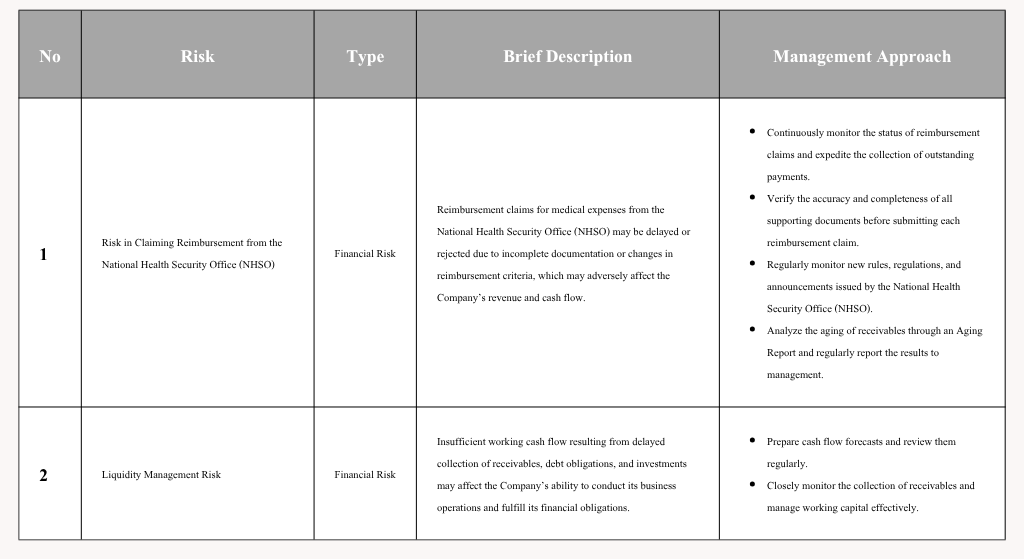
As a significant portion of the Company’s revenue is derived from government agencies, there may be delays in verification, approval, and reimbursement processes in accordance with applicable regulations and policies.
Currently, outstanding receivables have been submitted for appeal and reimbursement through the system. Certain portions remain pending, awaiting clarification, revision, or resubmission as requested by the relevant government agencies. The Company continues to closely monitor and follow up on these matters through formal written correspondence on a regular basis.
Liquidity Risk
The Company and its subsidiaries manage liquidity risk by maintaining adequate levels of cash and cash equivalents to support ongoing operations. In addition, the Company secures short-term credit facilities from financial institutions as a contingency measure to mitigate potential cash flow fluctuations.
Furthermore, the provisions recognized in 2025 do not have any impact on the Company’s liquidity position.
Other Analysis
| Title | Description | ||||||||||||||||||||||||||||||||||||||||||||||||||||||||||||||||||||||||||||||||||||||||||||||||||||||||||||||||||||
|---|---|---|---|---|---|---|---|---|---|---|---|---|---|---|---|---|---|---|---|---|---|---|---|---|---|---|---|---|---|---|---|---|---|---|---|---|---|---|---|---|---|---|---|---|---|---|---|---|---|---|---|---|---|---|---|---|---|---|---|---|---|---|---|---|---|---|---|---|---|---|---|---|---|---|---|---|---|---|---|---|---|---|---|---|---|---|---|---|---|---|---|---|---|---|---|---|---|---|---|---|---|---|---|---|---|---|---|---|---|---|---|---|---|---|---|---|---|
| Overall Economic Conditions, Private Hospital Industry Outlook, and Changes in Government Policies (National Health Security Office and Social Security Scheme) | Over the next year, the private hospital industry is expected to continue benefiting from Thailand's transition into an aging society, which is driving increasing demand for the treatment of chronic and complex diseases, rehabilitation services, and long-term care. In addition, growing public awareness of preventive healthcare and the increasing preference for specialized medical services are expected to further support industry growth. Meanwhile, health insurance coverage continues to facilitate access to healthcare services. International patients also remain an important growth driver, particularly for large private hospitals with strong capabilities in medical tourism and the treatment of complex medical conditions. Nevertheless, the industry continues to face several challenges, including a limited recovery in consumer purchasing power, relatively high medical expenses, and co-payment requirements under health insurance policies, which may lead patients to postpone non-essential medical treatments. Revenue from international patients also remains susceptible to fluctuations arising from geopolitical risks. Furthermore, hospitals continue to experience elevated costs associated with medical personnel, pharmaceuticals, medical supplies, and medical equipment. At the same time, competition is intensifying as healthcare providers expand their bed capacity and establish additional specialized medical centers. Consequently, hospitals with diversified patient bases, comprehensive specialized medical services, and effective cost management capabilities are expected to maintain a competitive advantage over operators that primarily rely on general patient services. Changes in Government Healthcare Policies in 2026Policy changes introduced by the National Health Security Office (NHSO) and the Social Security Office (SSO) in 2026 represent a significant turning point for Thailand's private hospital industry, with direct implications for hospital revenue structures and business models. 1. National Health Security Office (NHSO) Policies — Universal Coverage Scheme (UCS)1.1 Stricter Budgetary Controls and Restrictions under the “30-Baht Healthcare Anywhere” Scheme The National Health Security Office (NHSO) has strengthened budgetary controls and revised the implementation criteria for the “30-Baht Healthcare Anywhere” scheme, particularly by limiting the number of visits to participating private clinics and pharmacies. These measures are intended to prevent inappropriate utilization of healthcare services and ensure that expenditures remain within the allocated budget. 1.2 Maintenance of Inpatient Reimbursement Rates The NHSO has announced that the preliminary inpatient reimbursement rate will be maintained at THB 8,350 per Adjusted Relative Weight (AdjRW) throughout 2026 to enhance confidence among contracted healthcare providers. At the same time, the NHSO has introduced more stringent auditing measures, including comprehensive reviews of supporting documentation for medical reimbursement claims throughout the year, with the aim of reducing medically unnecessary services and improving the efficiency of healthcare expenditure. 1.3 Potential Introduction of Optional Co-payment Arrangements Policy discussions and proposed amendments to the National Health Security Act have explored the possibility of introducing optional co-payment arrangements, allowing beneficiaries to pay additional charges for enhanced medical services or advanced medical technologies beyond the standard benefits provided under the Universal Coverage Scheme. If implemented, such arrangements could create opportunities for private hospitals to offer supplementary healthcare services to patients covered under the Universal Coverage Scheme, potentially generating additional revenue streams. 2. Social Security Office (SSO) Policies2.1 Structural Reform of the Social Security System A working group has been established to study potential structural reforms of the Social Security Office (SSO), with the objective of enhancing the flexibility and efficiency of social security fund management. The proposed reforms also include consideration of adjustments to medical reimbursement rates to better reflect the actual costs incurred by healthcare service providers. | ||||||||||||||||||||||||||||||||||||||||||||||||||||||||||||||||||||||||||||||||||||||||||||||||||||||||||||||||||||
| Overview and Rationale for Changes in the Company's Strategic Plan | In 2025, the National Health Security Office (NHSO) revised its policy under the “30-Baht Healthcare Anywhere” scheme by requiring referral documents from primary care units and implementing stricter verification procedures for medical reimbursement claims. Under the revised policy, primary care units were responsible for approving reimbursement claims and were authorized to request and review patients' complete medical histories and medical records. These changes resulted in delays in the reimbursement process. In response, the Company adjusted its strategic plan by applying to become a Primary Care Unit and Regular Service Unit under the NHSO to mitigate delays in medical reimbursement payments and address issues related to the verification and accuracy of medical records. However, the capitation-based payments received from the NHSO were insufficient to cover the increasing medical treatment costs associated with the number of patients receiving services at the hospitals. Consequently, IMH Thonburi Hospital recorded an operating loss in the third quarter of 2025. As a result, IMH Thonburi Hospital withdrew from its status as a Primary Care Unit and Regular Service Unit while continuing to provide medical services as a Referral Service Unit for patients covered under the Universal Coverage Scheme (UCS) only. The hospital also implemented cost-reduction measures to align its operating expenses with the number of eligible patients receiving medical services. Meanwhile, IMH Silom Hospital continues to operate as a Primary Care Unit and Regular Service Unit under the NHSO, as it is able to optimize the utilization of medical equipment and healthcare personnel by sharing resources across services provided to patients under different healthcare coverage schemes. | ||||||||||||||||||||||||||||||||||||||||||||||||||||||||||||||||||||||||||||||||||||||||||||||||||||||||||||||||||||
| Analysis of Cash Flows, Liquidity, Risks and Risk Management, and Financial Ratios under Debt Covenant Requirements |
Key Financial Ratios
Risk Management in the Event of Non-Compliance with Financial Covenants (Debt Covenants)Under the loan agreements, the Company is required to comply with certain financial covenants, including maintaining its direct and/or indirect shareholding in Mahesak Hospital Co., Ltd. and IMH Silom Hospital Co., Ltd., maintaining a Debt Service Coverage Ratio (DSCR) of not less than 1.00 times based on the consolidated financial statements, and maintaining a Debt-to-Equity Ratio (D/E Ratio) of not more than 2.00 times. As of December 31, 2025 and 2024, the Company was unable to maintain the required Debt Service Coverage Ratio and Debt-to-Equity Ratio in accordance with the aforementioned loan agreements. However, on December 17, 2025, the Company obtained a waiver from the bank regarding these financial covenant requirements. | ||||||||||||||||||||||||||||||||||||||||||||||||||||||||||||||||||||||||||||||||||||||||||||||||||||||||||||||||||||
| Changes in Trade Receivables, Aging Analysis of Receivables from the National Health Security Office (NHSO) and Social Security Office (SSO), and Allowance Policy | As of December 31, 2025, trade and other current receivables in the consolidated financial statements amounted to THB 45,626,494.45, representing a decrease of THB 22,649,666.10 from THB 68,276,160.55 in the previous year. The decrease was primarily attributable to the significant volume of health check-up services provided to migrant workers in 2025, which had a relatively shorter collection period of 30–45 days. In comparison, corporate annual health check-up services generally have a longer collection period of 45–120 days, as invoices are issued and payments are collected only after the corporate clients have reviewed and accepted the complete health examination results for all employees. Aging Analysis of Receivables from the National Health Security Office (NHSO) and Social Security Office (SSO)
The Company has established a policy for recognizing an allowance for expected credit losses (ECL) in accordance with Thai Financial Reporting Standard 9 (TFRS 9). The Company engages an independent external valuation firm to conduct an annual assessment of expected credit losses in compliance with applicable financial reporting standards. The assessment is subject to review by the Company's external auditor to ensure compliance with relevant accounting standards and regulatory requirements of the Securities and Exchange Commission (SEC). | ||||||||||||||||||||||||||||||||||||||||||||||||||||||||||||||||||||||||||||||||||||||||||||||||||||||||||||||||||||
| Factors or Events That May Affect the Company's Future Financial Position and Operating Performance (Forward-Looking Statements), Including External and Internal Factors | Factors or Events That May Materially Affect the Company's Future Financial Position and Operating Performance1. Government Policies and Budget AllocationsAs a significant portion of the Company's revenue is derived from the National Health Security Office (NHSO), changes in government healthcare policies, reimbursement regulations, and budget allocations may have a material impact on the Company's financial position and operating performance.
Medical reimbursement rates determined under the Diagnosis-Related Group (DRG) system or capitation-based payment arrangements may directly affect the Company's profitability. If government reimbursement rates are not adjusted in line with medical inflation, hospitals may experience declining gross profit margins or increasing medical treatment costs, potentially affecting their overall financial performance.
Delays in government procedures for verifying patient eligibility, reviewing medical claims, and approving reimbursement payments may directly affect the Company's cash flows and working capital management. Prolonged reimbursement periods could increase liquidity pressure and the need for additional working capital to support ongoing hospital operations. 2. Demographic Changes and Disease Patterns
Thailand's transition into an aged society is expected to increase demand for healthcare services, particularly among elderly patients covered under the Universal Coverage Scheme (UCS). Elderly patients generally have a higher prevalence of chronic diseases, such as diabetes and hypertension, as well as complex medical conditions requiring prolonged treatment and hospitalization. These factors may contribute to higher bed occupancy rates. However, if medical treatment costs exceed the applicable reimbursement rates or allocated budgets, revenue generated per patient may be insufficient to cover the associated costs, potentially affecting hospital profitability.
The emergence and re-emergence of infectious diseases, together with the increasing prevalence of complex medical conditions requiring expensive pharmaceuticals, specialized treatments, and advanced medical technologies, may place additional pressure on hospital operating costs and resource utilization. 3. Internal Hospital Cost Management
The costs of employing physicians, nurses, and specialized healthcare professionals are expected to continue increasing due to growing demand for qualified medical personnel and competition within the healthcare industry. If the Company is unable to attract and retain sufficient qualified personnel, it may become increasingly dependent on overtime arrangements or additional staffing resources, resulting in higher operating expenses and potentially affecting service efficiency and profitability.
A significant proportion of pharmaceuticals, medical equipment, and advanced healthcare technologies are imported and may therefore be subject to fluctuations in foreign exchange rates. Changes in exchange rates, procurement costs, and medical technology prices may increase the Company's operating expenses and capital expenditure requirements, potentially affecting profit margins and financial performance. 4. Competition and Digital Transformation
The adoption of telemedicine services, digital healthcare platforms, and integrated hospital information systems may enhance operational efficiency, improve patient service delivery, and reduce outpatient service costs. Furthermore, effective digital data management and electronic medical claims processing may improve the accuracy and efficiency of reimbursement submissions to the National Health Security Office (NHSO), potentially reducing administrative costs and reimbursement processing times. However, such investments may require additional capital expenditure, system maintenance, cybersecurity measures, and personnel training.
Hospitals that primarily serve patients under the Universal Coverage Scheme (UCS) may reduce their dependence on government reimbursement revenue by expanding their services to patients covered under the Social Security Scheme (SSS) and self-paying patients (Cash Patients). In particular, the development of specialized medical centers and additional healthcare services may create opportunities to diversify revenue sources, enhance revenue per patient, and improve overall profitability. Such diversification may also strengthen the Company's ability to manage risks arising from changes in government healthcare policies, reimbursement rates, and budget allocations. | ||||||||||||||||||||||||||||||||||||||||||||||||||||||||||||||||||||||||||||||||||||||||||||||||||||||||||||||||||||
Debt Securities with Financial Ratio Requirements
Debt Securities with Financial Ratio Requirements Issued?
No
Factors That May Affect Financial Condition
Factors or Incidents That May Materially Affect Financial Condition
The restatement of the financial statements arose from two key factors:
1. Reversal of Medical Service Claims from the National Health Security Office (NHSO)
During 2025, two subsidiaries were required by the National Health Security Office (NHSO) to return previously claimed medical service fees related to pulse oximetry and blood pressure measurements for the years 2023–2024.
Historically, such services were claimed under the NHSO fee schedule system, with service rates of Baht 100 per procedure for both pulse oximetry and blood pressure measurement, and the subsidiaries had already received payment for these services.
Subsequently, the NHSO conducted an online clarification session with hospitals participating in the Universal Coverage Scheme, informing that these two services are not eligible for separate reimbursement, as they are already included in nursing service fees. As a result, from 2025 onward, the subsidiaries have ceased claiming such service fees.
Impact:
Additional net loss of Baht 25,067,773.13 for 2023
Additional net loss of Baht 12,013,735.75 for 2024
2. Non-recognition of Right-of-Use Assets – Land Lease for IMH Bearing Project
The Company did not previously recognize right-of-use assets related to the land lease for the IMH Bearing hospital project, as the Company had not yet commenced utilization of the land. However, an agreement to utilize the land had already been executed as an addendum to the main lease agreement.
Currently, the Company is in the process of preparing and submitting the Environmental Impact Assessment (EIA) for approval.
Impact:
Additional net loss of Baht 21,325,433.54 for 2023
Additional net loss of Baht 16,640,768.55 for 2024